Will Roof Cleaning Chemicals Harm My Landscaping?
Pre-wash plant protection, runoff containment, sodium hypochlorite dilution, what to do if plants stress.
Homeowners often ask us, will roof cleaning chemicals harm plants?
The short answer is no, not when you use the proper techniques. From what we see every day at Elite Pressure Washing Raleigh, protecting delicate landscaping is the true mark of a professional job. We are going to walk you through exactly how the right prep work keeps your greenery safe.
Understanding this process helps you see exactly why soft wash roof cleaning is the smart choice.
The protocol works
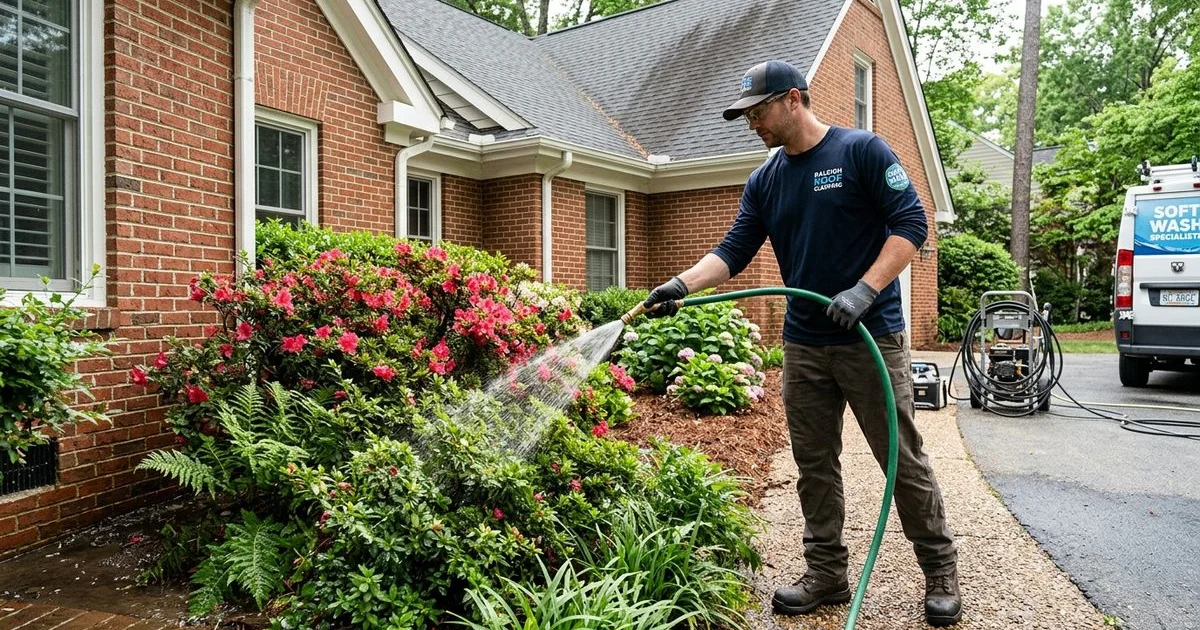
Every soft washing visit follows a documented landscaping protection protocol that guarantees plant safety. We use a precise sequence of pre-soaking, covering, and neutralizing to ensure chemicals never harm your beds. Local favorites like hostas, ferns, azaleas, and hydrangeas survive the process perfectly when the right steps are taken.
Our protocol works because dilution starts before runoff begins. Saturating the soil with fresh water ensures any errant chemistry is instantly weakened below stress concentration. Hydrated plants actually absorb far less chemical runoff because their root systems are already full of clean water.
We apply specialized neutralizing agents like Plant Wash to restore soil pH after the cleaning. This extra step provides absolute insurance against accidental overspray.
What we do, in order
Our process relies on a strict six-step system to protect every single leaf and stem on your property. This creates a physical and chemical barrier between your plants and the roof runoff.
We start every job by walking the property to identify vulnerable zones. Identifying high-risk areas allows the crew to customize the prep work. Our team then executes these exact steps:
- Pre-saturate landscaping: Foundation plantings get a 10-minute fresh-water soak before any chemicals are mixed.
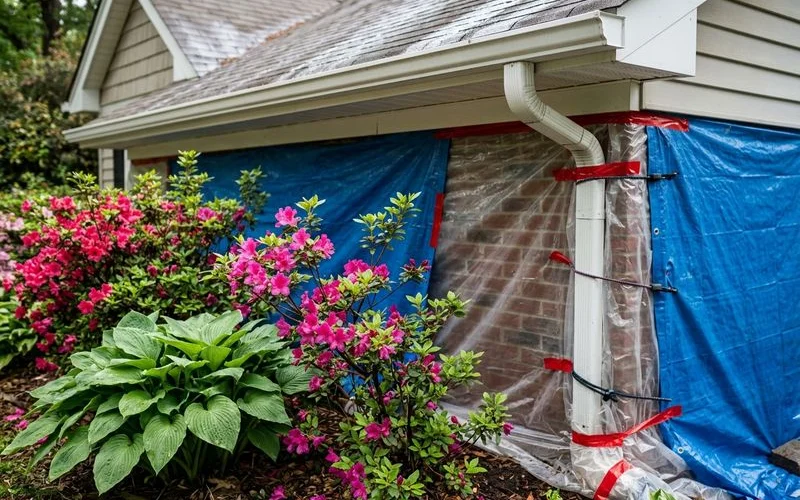
- Bag the downspouts: Runoff naturally flows into gutters and down the spouts. We bag these exits to catch chemical-heavy water before it dumps into your flower beds.
- Tarp sensitive plantings: Delicate vegetation gets covered with breathable tarps during the wash. Plastic sheeting can actually cook plants in the hot North Carolina sun.
- Apply soft-wash chemistry: The mixture of sodium hypochlorite and biodegradable surfactant is applied at under 100 PSI. This pressure is roughly equivalent to a standard garden hose.
- Dwell and rinse: The cleaning agent sits just long enough to kill the algae. A low-pressure rinse then safely washes it away.
- Final landscaping rinse: A heavy post-rinse flushes all nearby soil to eliminate residual chemicals. We uncover the protected areas to confirm everything looks healthy.
Why the chemistry is more forgiving than people think
The main ingredient used in soft washing is sodium hypochlorite, which is highly manageable when diluted correctly. We apply this solution at very specific ratios to maximize soft wash plant safety. You might be surprised to learn it is the exact same active ingredient found in standard pool sanitizer.
Our crews monitor these concentrations carefully. A typical roof wash mixture uses a 12.5% concentrate that gets diluted down to roughly 3% to 6% on the shingles. The pre-rinse water dilutes it well below 1% by the time it reaches the ground.
We know the chemical breaks down into harmless salt and water within a matter of hours. Standard lawn herbicides applied directly to grass are routinely more dangerous than this indirect roof runoff. Here is a quick look at how soft washing compares to common household and yard chemicals:
| Chemical Application | Typical Concentration | Direct Impact on Soil |
|---|---|---|
| Standard Household Bleach | 5.25% to 6% | High risk if undiluted |
| Soft Wash Roof Runoff | Under 1% (After pre-wetting) | Minimal risk |
| Commercial Weed Killer | Highly Concentrated | Designed to kill vegetation |
If a plant stresses
If an individual plant does stress after a cleaning, the recovery is almost always fast and full. We rarely see this happen when the prep work is done correctly. Drooping leaves or browning edges are the most common signs of fatigue, but they rarely mean the plant is dying.
Our recommended remediation is just thorough watering for two or three days to flush any residual salt from the root zone. Adding agricultural gypsum to the soil is an insider trick that helps displace excess sodium quickly. This simple mineral application accelerates the plant’s recovery time.
“Pre-wash planning is the ultimate secret to roof wash landscaping protection. Identifying vulnerabilities before a single drop of water is sprayed prevents accidents entirely.”
We conduct an on-property walk before the wash begins for properties with extensive landscaping. Documenting everything that needs special attention is standard practice for every single job.
So, will roof cleaning chemicals harm plants? The reality is that your garden is completely safe when the cleaning is handled by professionals. We take the guesswork out of exterior cleaning so you can enjoy a spotless roof and a thriving landscape.
Frequently Asked Questions
What if I have a vegetable garden near the house?
Will my fish pond be affected?
Are there plants that are particularly sensitive?
Learn more about
Soft Wash Roof CleaningSub-100 PSI roof soft washing that kills Gloeocapsa magma, lichen, and moss without damaging asphalt shingles or voiding manufacturer warranties.
Related Guides
Black Streaks on Roof: Gloeocapsa Magma Explained
Gloeocapsa magma ID, why streaks return without biocide, NC humidity enabler, treatment lifespan.
How Often Should You Have Your Roof Cleaned in Raleigh?
3-5 year general cadence; tree-shade and north-slope acceleration; post-storm inspection prompts.
How Much Does Roof Cleaning Cost in North Carolina?
NC roof-cleaning prices by size and pitch, story differential, severity scaling, gutter bundle savings.
Will Roof Cleaning Damage My Asphalt Shingles or Void Warranty?
ARMA position, GAF/Owens Corning stance, why pressure wash voids warranty but soft wash doesn't.